
PROGRAM LEVEL
The Bachelor of Architecture program at the College of Engineering is a unique program designed to develop creativity, technical proficiency, and critical thinking. Students engage in a mix of theoretical and practical courses, with the focus of applying this knowledge in the core design courses.
This enables students to address complex architectural challenges and contribute to the built environment responsibility. The program emphasizes social, environmental, technical, and historical aspects, providing students with an integrated approach to design. Since 2015, the five-year program has met the rigorous standards of the National Architectural Accrediting Board (NAAB) and obtained international certification, allowing students to pursue learning and working opportunities worldwide.
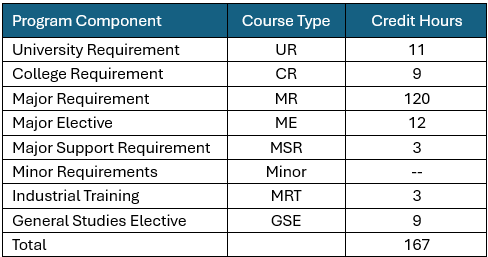
The 2024 curriculum consists of 167 credit hours, including 11 credit hours for University Requirements, 9 credit hours for College Requirements, 3 credit hours for Major Supporting Courses, 120 credit hours for Major courses, 12 credit hours for Major Electives, 9 credit hours for General Studies Electives, and 3 credit hours for industrial training.
THE CURRICULUM OF BACHELOR OF ARCHITECTURE IS COMPOSED OF 167 CREDIT HOURS:
ABOUT THE PROGRAM
DETAILED STUDY PLAN
- Bachelor of Architecture 2026 (PDF، 0.8 MB، 34 Pages)
- Bachelor of Architecture 2024 (PDF، 0.8 MB، 34 Pages)
- Bachelor of Architecture 2014 (PDF، 0.4 MB، 14 Pages)
NAAB INTERNATIONAL CERTIFICATION
University of Bahrain, program of Bachelor of Science (BSc) in Architecture has received the Substantial Equivalency designation from the National Architectural Accrediting Board. A substantial equivalency was granted in 2015 for a term of six years.
The term “International Certification” identifies a program as comparable in educational outcomes in all significant aspects to a program accredited by the NAAB in the United States and indicates that it provides an educational experience meeting acceptable standards, even though such program may differ in format or method of delivery. The designation is valid for six years beginning 1 January of the year in which the final visit (Visit 3) took place. In order to maintain the designation, the program must be visited again in the sixth year of the designation.
Schools with programs identified as holding NAAB International Certification (previously Substantial Equivalency) are not formally “accredited” as that term is used with reference to programs in the United States and may not refer to their programs as “accredited” by the NAAB. However, students who graduate from internationally certified programs are able to apply for individualized review of their credentials on an expedited basis for purposes of the Educational Evaluation Services for Architects program administered by the NAAB on behalf of the National Council of Architectural Registration Boards.
The following documents are available in the (library or other public area) and also may be downloaded from the University of Bahrain website:
- 2019 Conditions for NAAB International Certification (PDF، 0.2 MB، 33 Pages).
- 2019 Procedures for NAAB International Certification (PDF، 0.4 MB، 62 Pages).
- Visiting Team Report for NAAB ICert 2021 (PDF، 1.2 MB، 32 Pages).
- Decision letter from NAAB, stating that ICert has been granted (PDF، 0.2 MB، 1 Page).
- Program Self-Evaluation Report 2021 final (PDF، 2.7 MB، 109 Pages).
PROGRAM OBJECTIVE
- To provide educational opportunities to students to understand the complex nature of architecture as a socially conscious design activity.
- To develop an effective environment for teaching, learning and research.
- To facilitate engagement in research and scholarly activities.
- To contribute to interdisciplinary and multi-disciplinary teaching and research programs.
- To serve the community by working with government agencies, private sector, and professional organizations.
- To maintain and continue to enrich the program itself by advancing the quality of education in architecture.
PROGRAM INTENDED LEARNING OUTCOMES
- Communicate complex architectural concepts effectively, to diverse audiences, by utilizing written, verbal, visual and digital methods.
- Employ design thinking skills, architectural design skills and ordering systems skill to develop designs.
- Utilize investigative and research skills to analyze functions, forms, and systems, assessing their impact on human behavior, reflecting upon precedents derived from history and global culture as related to societal needs, cultural diversity and social equity.
- Produce technically articulate documentations indicating appropriate building materials and assemblies for buildings using digital media.
- Develop comprehensive pre-design architectural programs comprised of an inventory of spaces responding to user needs, a site analysis, building codes and standards, site selection and design assessment criteria including sustainability requirements.
- Produce site design responding to site characteristics, urban context, developmental patterns, historical fabric, soil, topography, ecology, climate and building orientation, providing accessibility to people including those with disabilities while ensuring life safety in an emergency.
- Produce integrative design by employing structural systems, building envelope systems, environmental systems, building service systems and sustainable design principles.
- Develop comprehensive designs derived from theoretical and philosophical ideas to address social, spatial and environmental issues and their implications for human behavior to produce sustainable built-environments compliant with building codes and regulations.
- Apply management, leadership and collaboration skills to supervise building projects and architectural businesses across diverse processes to effectively manage costs, manpower and other financial considerations.
- Apply knowledge of legal and social responsibilities and an understanding of stakeholder roles in architecture in reconciling diverse needs and the implications of human behavior to produce architecture within a professional and ethical framework.
PROGRAM COORDINATOR
 Dr. Omaima Abdulaziz Alabbasi